
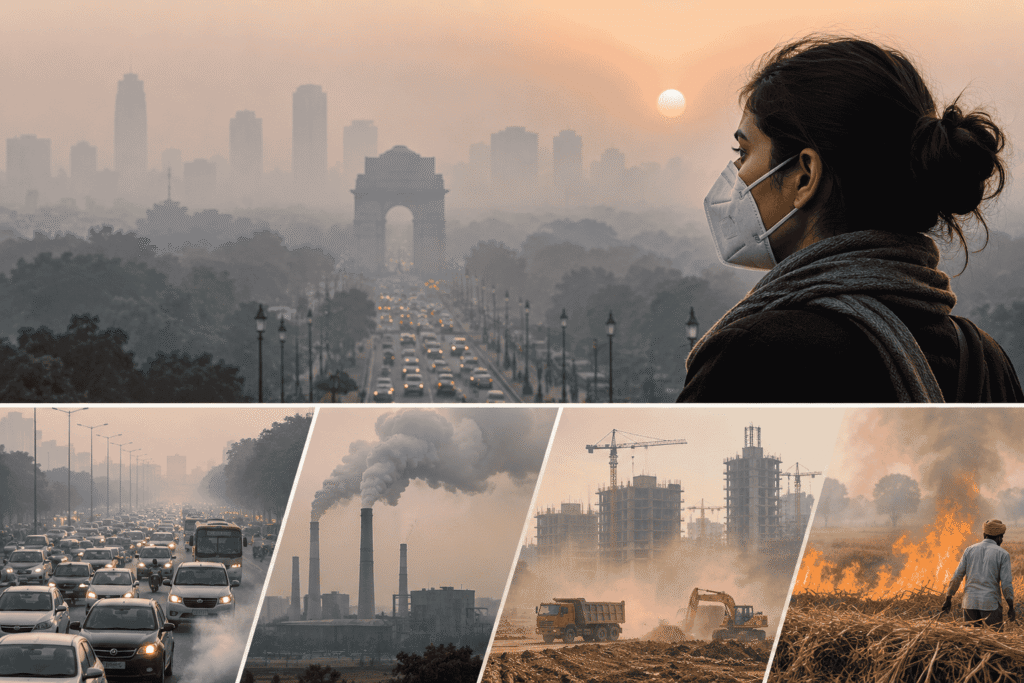
Imagine waking up early on a winter morning in Delhi NCR. You step outside for your morning walk, but instead of fresh air, you find a layer of grey haze covering the roads and buildings.
Your eyes feel irritated, your throat becomes uncomfortable, and even a short walk makes you wonder whether going outside is safe.
For people living in Delhi, Faridabad, Gurugram, Noida and other parts of the National Capital Region (NCR), this experience is becoming increasingly familiar.
Air pollution is not just an environmental issue. It affects our everyday lives, from the air children breathe while going to school to the health of people commuting to work and older adults spending time outdoors.
Although pollution often becomes more noticeable during winter, it is a year-round problem. Vehicle emissions, industrial activities, construction dust, waste burning and changing weather conditions all contribute to poor air quality.
But how dangerous is the air we breathe? What causes Delhi NCR’s pollution, how does it affect our health, and what practical steps can we take to reduce our exposure?
Let’s understand the problem and explore what individuals, communities and authorities can do to make the air cleaner.
Table of Contents
- Why Is Air Pollution Becoming a Silent Killer?
- When Is Air Considered Polluted?
- Types of Air Pollution
- Understanding the Air Quality Index (AQI)
- Why Is Air Pollution So High in Delhi NCR?
- Health Impacts of Air Pollution and Life Expectancy
- Solutions and Steps to Reduce Air Pollution
- Conclusion
1. Why Is Air Pollution Becoming a Silent Killer?
Air pollution is often called a silent killer because its harmful effects can develop gradually without obvious warning signs.
Unlike an accident or an infectious illness that may produce immediate symptoms, prolonged exposure to polluted air can contribute to serious health problems over months and years. Some pollutants are invisible, meaning that the air can look clear even when it contains harmful substances.
According to the World Health Organization (WHO), air pollution is associated with millions of premature deaths worldwide every year. It increases the risk of respiratory diseases, cardiovascular problems, lung cancer and stroke.
One of the biggest concerns is fine particulate matter, particularly PM2.5. These tiny particles can travel deep into the lungs, and some components can enter the bloodstream.
For people living in heavily polluted cities, breathing polluted air can become part of everyday life. The danger is not always a single exposure but the repeated exposure that accumulates over time.
Clean air should not be considered a luxury. It is essential for human health and quality of life.
2. When Is Air Considered Polluted? Common Air Pollutants
Air is considered polluted when harmful substances are present in the atmosphere at concentrations that pose risks to human health, animals, plants or the environment.
Some pollutants come directly from sources such as vehicle exhausts, factories and burning waste. Others form in the atmosphere when different gases react with sunlight and other chemicals.
The most common air pollutants include:
PM2.5 and PM10
Particulate matter consists of tiny solid particles and liquid droplets suspended in the air.
- PM2.5: Fine particles measuring 2.5 micrometres or less in diameter. They can penetrate deep into the lungs.
- PM10: Particles measuring 10 micrometres or less. They include dust, pollen and other particles that can enter the respiratory system.
Construction activities, road dust, vehicle emissions, industrial processes and burning fuels can release particulate matter.
Nitrogen dioxide (NO2)
Nitrogen dioxide is a gas mainly associated with combustion, including traffic, power generation and industrial activities. High exposure can irritate the respiratory system and worsen existing lung conditions.
Sulphur dioxide (SO2)
Sulphur dioxide is released primarily through burning sulphur-containing fuels and certain industrial processes. It can irritate the airways and contribute to the formation of secondary particles.
Carbon monoxide (CO)
Carbon monoxide is a colourless, odourless gas produced by incomplete combustion. High concentrations can interfere with the blood’s ability to transport oxygen.
Ground-level ozone (O3)
Ground-level ozone is not emitted directly. It forms when nitrogen oxides and volatile organic compounds react in sunlight. It can irritate the lungs and worsen asthma.
3. Types of Air Pollution
Air pollution can be classified according to where it occurs and how it originates.
Outdoor air pollution: This includes pollution from traffic, industries, construction sites, power plants, agricultural burning and other outdoor sources. It is a major concern across Delhi NCR.
Indoor air pollution: Indoor air can be contaminated by cooking smoke, tobacco smoke, poor ventilation, cleaning chemicals and other sources. Indoor pollution can also become a concern when outdoor pollutants enter buildings.
Natural air pollution: Dust storms, wildfires, pollen and certain volcanic emissions can contribute to poor air quality. In northern India, dust storms can also carry particles across regional boundaries.
Human-made air pollution: This results from activities such as burning fossil fuels, operating vehicles, manufacturing goods, generating electricity and burning waste.
In reality, these categories can overlap. A city may experience pollution from both human activities and natural events at the same time.
4. Understanding the Air Quality Index (AQI)
The Air Quality Index (AQI) is a numerical system that helps people understand the current level of air pollution and its potential health effects.
In India, the Central Pollution Control Board (CPCB) uses six AQI categories.
| AQI range | Category | General meaning |
|---|---|---|
| 0–50 | Good | Minimal impact on health |
| 51–100 | Satisfactory | Minor breathing discomfort for sensitive people |
| 101–200 | Moderate | Breathing discomfort may affect sensitive people |
| 201–300 | Poor | Breathing discomfort may affect many people with prolonged exposure |
| 301–400 | Very Poor | Respiratory illness risk increases with prolonged exposure |
| 401–500 | Severe | Health effects may occur even in healthy people; existing conditions can worsen |
Source: India’s National Air Quality Index classification.
A higher AQI indicates poorer air quality. However, AQI is a communication tool rather than a complete measurement of a person’s total pollution exposure.
It is also important to understand that India’s AQI categories differ from those used in some other countries. Therefore, numerical readings should not be compared internationally without considering the measurement systems.
Before going for a morning run, cycling or an outdoor workout, check the local AQI. When pollution levels are high, reduce strenuous outdoor activity and follow official health advisories.
5. Why Is Air Pollution So High in Delhi NCR?
Delhi NCR includes Delhi and surrounding urban areas across Haryana, Uttar Pradesh and Rajasthan. Its large population, transportation networks, industries and construction activities create a complex pollution problem.
5.1 Vehicle emissions and traffic congestion
Cars, motorcycles, buses, trucks and other vehicles release pollutants through fuel combustion. Congested roads, frequent braking and idling can add to local emissions.
As urban areas expand, longer commuting distances and increased vehicle use can make controlling transport-related pollution more challenging.
5.2 Construction and road dust
Rapid urban development involves road construction, building projects, demolition and the transportation of materials. Without proper dust suppression, these activities can release large quantities of particulate matter.
Dust from poorly maintained roads and exposed soil can also be resuspended by passing vehicles.
5.3 Industrial emissions and power generation
Factories, industrial boilers, diesel generators and other combustion sources can release particulate matter and gases that contribute to poor air quality.
Pollution does not stop at municipal or state boundaries. Emissions from different parts of the wider NCR airshed can affect neighbouring areas.
5.4 Crop-residue and waste burning
Burning crop residue releases smoke and fine particles. Its contribution to pollution episodes depends on the timing, location, weather and the combination of other emission sources.
Open burning of household waste, leaves and other materials adds further pollutants. Better waste collection, alternatives to residue burning and effective enforcement are important parts of the solution.
5.5 Weather conditions and winter pollution
Winter weather plays a significant role in Delhi NCR’s pollution episodes.
Low wind speeds can prevent pollutants from dispersing. Temperature inversions can trap polluted air near the ground, while seasonal weather conditions may reduce the ventilation of the atmosphere.
This explains why pollution can become especially severe during autumn and winter, even though emissions also occur during the rest of the year.
What Do the Latest Air Pollution Facts Tell Us?
Air pollution is a global public health concern, but the situation in Delhi NCR deserves particular attention.
According to the Commission for Air Quality Management (CAQM), Delhi recorded an annual average PM2.5 concentration of 97 micrograms per cubic metre (µg/m³) in 2025, compared with 105 µg/m³ in 2024.
Although this was an improvement, the level remained significantly higher than the World Health Organization’s recommended annual PM2.5 guideline of 5 µg/m³.
Here are some important facts:
- Delhi’s annual average PM2.5 in 2025: 97 µg/m³, according to CAQM.
- WHO annual PM2.5 guideline: 5 µg/m³.
- Global health impact: WHO estimates that outdoor air pollution caused approximately 4.2 million premature deaths worldwide in 2019.
- Combined pollution impact: Outdoor and household air pollution together were associated with approximately 6.7 million premature deaths in 2019.
These figures show why air pollution cannot be treated as just a seasonal inconvenience.
Even when annual pollution levels improve, continued exposure to unhealthy air remains a serious public health concern.
Note: Global estimates refer to 2019, while Delhi’s PM2.5 figure refers to 2025. These are different measurement periods.
6. Health Impacts of Air Pollution and Life Expectancy
Air pollution can affect nearly every organ system, although the respiratory and cardiovascular systems are particularly vulnerable.
Respiratory problems
Exposure to polluted air can irritate the nose, throat and lungs. It can worsen asthma, contribute to chronic respiratory diseases and increase the risk of respiratory infections.
Children are especially vulnerable because their lungs are still developing.
Heart disease and stroke
Fine particles can contribute to inflammation and other biological changes that increase the risk of cardiovascular disease. Long-term exposure is associated with a higher risk of heart attacks and strokes.
Effects on children and older adults
Children, older adults, pregnant people and individuals with existing heart or lung conditions may face greater risks. Poor air quality can also affect children’s lung development and pregnancy outcomes.
Can air pollution reduce life expectancy?
Yes. Research indicates that long-term exposure to particulate pollution can shorten life expectancy at a population level.
The Clean Air Fund cites research estimating a global average reduction of approximately 2.2 years due to particulate air pollution. This is a population-level estimate, not a prediction that every individual will lose exactly that amount of life.
The actual risk depends on factors such as pollution levels, duration of exposure, age, existing health conditions and other environmental and lifestyle factors.
Reducing air pollution can therefore improve not only immediate breathing comfort but also long-term public health.
7. How Can Delhi NCR Residents Protect Themselves from Air Pollution?
We cannot control every source of pollution, but we can take sensible precautions to reduce our exposure.
Here are some practical steps to follow in everyday life.
1. Check the AQI before going outside
Before going for a morning walk, running, cycling or outdoor exercise, check the local Air Quality Index (AQI).
Avoid relying only on the appearance of the sky. Air can contain harmful pollutants even when visibility looks normal.
You can check official air-quality readings through the CPCB Air Quality Dashboard.
2. Avoid strenuous outdoor exercise when pollution is high
Running and exercising outdoors can increase the amount of air you breathe. During periods of poor air quality, consider exercising indoors instead.
Children, older adults and people with existing heart or lung conditions should take particular care and follow official health advice.
3. Use a well-fitting N95 respirator when needed
If you must travel outdoors during periods of heavy particle pollution, a properly fitted N95 respirator can help reduce exposure to airborne particles.
Ordinary cloth masks and loose-fitting masks should not be treated as equivalent protection.
4. Keep indoor air cleaner
Pollution can enter homes through doors, windows and ventilation systems.
During severe outdoor pollution episodes, keep windows closed when appropriate, avoid indoor smoking and unnecessary burning, and consider a properly sized air purifier with an effective particle filter if practical.
5. Reduce pollution through everyday choices
Small choices can contribute to cleaner surroundings:
- Use public transport or carpool when possible.
- Avoid unnecessary vehicle idling.
- Maintain your vehicle regularly.
- Never burn leaves or household waste in the open.
- Support proper waste disposal and dust-control practices.
Personal precautions can help reduce exposure, but long-term improvement requires coordinated action from governments, industries and communities.
8. Solutions and Steps to Reduce Air Pollution
Solving Delhi NCR’s air pollution problem requires coordinated action from governments, businesses, communities and individuals. Personal precautions can reduce exposure, but lasting improvement depends on reducing pollution at its sources.
What governments and authorities can do
Improve public transport: Expand reliable metro, bus and other public transport services to reduce dependence on private vehicles.
Control industrial emissions: Enforce emission standards, improve pollution monitoring and encourage cleaner technologies and energy sources.
Manage construction dust: Require covered construction materials, effective site barriers, appropriate water spraying and dust control at demolition sites.
Prevent open burning: Improve waste collection, segregation and disposal, and provide farmers with practical alternatives to crop-residue burning.
Coordinate across NCR: Pollution travels across administrative boundaries, so Delhi, Haryana, Uttar Pradesh, Rajasthan and relevant central agencies need coordinated, year-round action.
Publish reliable air-quality information: Monitoring stations, public reporting and timely health advisories help people and authorities respond appropriately.
What individuals can do
- Use public transport, carpool, walk or cycle when conditions are suitable.
- Maintain vehicles and avoid unnecessary idling.
- Never burn household waste or dry leaves in the open.
- Save electricity and choose cleaner energy options where practical.
- Check the AQI before outdoor exercise or other strenuous activities.
- When pollution is high, reduce prolonged outdoor exertion and consider a well-fitting N95 or equivalent respirator when exposure cannot be avoided.
- Keep indoor air cleaner by avoiding smoking, incense or other unnecessary combustion indoors and using appropriate ventilation or filtration where feasible.
Individual action matters, but it cannot replace effective public policies and large-scale emission reductions.
9. Frequently Asked Questions About Air Pollution
1. Why is Delhi NCR air pollution worse during winter?
During winter, low wind speeds and temperature inversions can prevent pollutants from dispersing. This allows pollution from vehicles, industries, dust and burning activities to accumulate near the ground.
2. What is a safe AQI level in India?
According to India’s National AQI classification, 0–50 is Good, 51–100 is Satisfactory, 101–200 is Moderate, 201–300 is Poor, 301–400 is Very Poor and 401–500 is Severe.
Even at lower AQI levels, sensitive individuals may experience discomfort.
3. Does an N95 mask help against air pollution?
A properly fitted N95 respirator can reduce exposure to airborne particles such as PM2.5. However, it does not protect against every gaseous pollutant.
4. Can air pollution affect children?
Yes. Children are particularly vulnerable because their lungs are still developing. Exposure to polluted air can affect respiratory health and worsen conditions such as asthma.
5. How can I check the air quality in my area?
You can check current air-quality readings using the Central Pollution Control Board’s official AQI dashboard. Readings can vary between monitoring stations, so check the location closest to you.
10. Conclusion: Clean Air Is a Shared Responsibility
Air pollution in Delhi NCR is not simply a winter problem. It is a year-round environmental and public health challenge that affects the quality of life of millions of people.
From vehicle emissions and construction dust to industrial activities and waste burning, several factors contribute to the air we breathe.
Checking the AQI, reducing outdoor exposure during severe pollution episodes and making responsible everyday choices can help protect us. However, individual precautions alone cannot solve the problem.
We need cleaner transportation, better waste management, stronger pollution controls and coordinated action across the entire NCR region.
Clean air should not be a privilege enjoyed by a few. It should be a basic expectation for everyone.
What do you think is the biggest reason behind air pollution in Delhi NCR? Are authorities doing enough, or do citizens also need to change their everyday habits? Share your thoughts in the comments below.


I found the section on air pollution and life expectancy particularly interesting. Pollution is not just about breathing discomfort today; long-term exposure can affect people’s health and quality of life for years.
Thank you for reading! The long-term health consequences are exactly why clean air deserves greater attention in our everyday lives.
The connection between air pollution and long-term health problems is worrying. Fine particles like PM2.5 can be especially harmful because they penetrate deep into the lungs. Everyone should take this issue seriously.
Well said. Understanding the health effects of PM2.5 and other pollutants can help us recognize why reducing emissions is so important.